
One Office Lunch, Five Dietary Restrictions: How to Actually Order It

Written by Pierce Lydon • October 22, 2026

Here's a real list someone had to order lunch against last week:
One food allergy to potato and tomato. Two gluten-free. One dairy-free. One gluten and dairy-free. One vegetarian. Delivered no later than 12:30.
Six constraints, one order, one delivery window. If you've ever stared at a list like that and considered just ordering sandwiches and apologizing, this is the post for you. It's solvable — but not by hunting for a menu where every dish happens to clear every restriction. It's solved by picking the right format.
Start with the hardest restriction, not the most common one
Most people start with gluten-free because it's the most familiar. That's backwards. Start with whichever restriction rules out the most menus, because that one decides your cuisine.
On the list above, it's the potato and tomato allergy — and it's worth understanding why, because this one catches people.
Potatoes and tomatoes are both nightshades. So are bell peppers, chili peppers, and the spices made from them: paprika, cayenne, chili powder, and most generic "taco seasoning" blends. That single allergy quietly eliminates:
- Most Mexican (salsa, most sauces, most seasoning blends)
- Most Italian and most pizza (tomato sauce)
- Most BBQ (tomato-based sauce, paprika rubs)
- Most Indian curries (tomato base, often chili)
- Anything with potatoes as the side, which is a lot of classic American catering
That's not a small carve-out, and it's the reason "we'll just get Mexican, there are always veggie options" can still miss. Meanwhile gluten-free and dairy-free are comparatively easy — plenty of cuisines are naturally built without wheat or dairy.
So the cuisine that survives is something Mediterranean, Middle Eastern, or Asian-leaning: rice or quinoa bases, grilled proteins, cucumber and herbs, olive oil and lemon rather than tomato and cream. CaterCow can help verify the spice blends and any harissa or chili sauce, but the core of the menu works.
The format that solves it: components served separately
The single highest-leverage decision is ordering a build-your-own bar rather than composed plates.
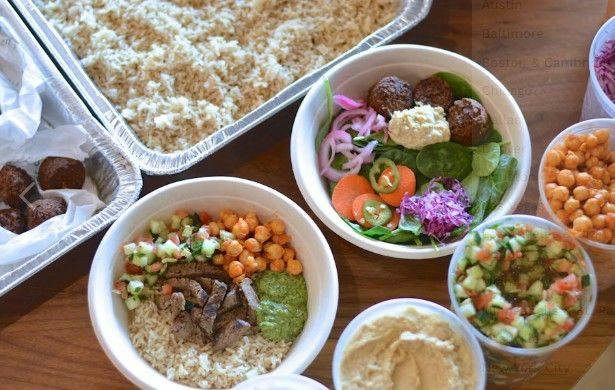
When the rice, the protein, the vegetables, the sauces, and the bread arrive in separate containers, every person on your list assembles a lunch that works for them without you having to order six different meals. Your gluten-free people skip the pita. Your dairy-free person skips the feta and tzatziki. Your nightshade-allergic colleague skips two toppings instead of the whole entrée. The vegetarian builds the same bowl with chickpeas.
One order. One delivery. No one eating a sad side salad while everyone else eats lunch.
The alternative — individually boxed meals, ordered per person — is the right call when separation genuinely matters more than variety, or when people are eating at their desks rather than at a table. More on when to pick which below.
Here are live formats that work this way:
Build Your Own Quinoa & Rice Bar from Creative Ideas Catering SF- ⭐ 4.97 · $17.95 / person- A grain base with proteins and vegetables kept separate — about as accommodating as a single order gets, and no bread in the foundation.
DIY Healthy Mediterranean Fast Casual Buffet from Noon Mediterranean- ⭐ 4.91 · $15.25 / person- Mediterranean is the cuisine that most often survives a long restriction list, and a fast-casual line format keeps every component in its own tray.
Build Your Own Boltiful Bowl Bar from Boltiful Fresh Kitchen- ⭐ 5.0 · $14.00 / person- The best per-head value of the bunch, and bowls are the easiest format to build around a restriction.
Build Your Own Salad Bar from Salad World- ⭐ 4.95 · $15.95 / person- Maximum component separation. Add a grain or protein so it reads as lunch rather than a side.
Make Your Own Fresh Mediterranean Bowls from Dill & Parsley- ⭐ 4.86 · $17.50 / person- Herb-and-lemon forward rather than tomato-forward, which is exactly what a nightshade allergy needs.
Availability and pricing vary by market — browse build-your-own salad bars and healthy bowls or Mediterranean bowls, gyros and wraps to see what's live in your city.
One important caveat: we're recommending formats, not certifying ingredients. Whether a particular package is free of a particular allergen depends on that restaurant's recipes and kitchen, so confirm specifics before you order — which brings us to the next part.
What to ask the restaurant (and what an allergy actually requires)
There's a real difference between a preference, an intolerance, and an allergy, and it changes what you need to ask.
For preferences and mild intolerances, an ingredient list is usually enough. For a genuine allergy — especially anything that's ever needed an EpiPen — you need to ask about cross-contact, not just ingredients:
- Is this dish made without [allergen], or made in a kitchen that also handles it? A build-your-own bar reduces cross-contact risk a lot; it doesn't eliminate it.
- Are shared utensils used between trays? Ask for separate serving utensils per container, which is a small request that solves a lot.
- What's in the spice blend and the sauce? This is where nightshades, dairy, and gluten hide. "Seasoned" is not an ingredient list.
- Is the gluten-free item prepared separately? Relevant for celiac disease specifically, where trace exposure matters.
- Can the allergen-free portion be packed separately? For a severe allergy, a sealed individual container is meaningfully safer than a buffet line.
For the most serious cases, don't make the buffet do the work: order that one person an individually boxed meal alongside the shared bar. It costs one extra entrée and removes the entire question.
Label everything, always
Whatever format you choose, labeling is what turns a good order into a calm lunch. Without it, every person with a restriction has to stand at the table interrogating trays, which is both annoying and unreliable.
When you order through CaterCow, labels include the employee's name, the food description, and dietary tags — so the person who can't have dairy doesn't have to ask anyone, and nobody eats something they shouldn't because a tray looked fine.
If your list is long or changes week to week, group ordering is the structural fix: each person picks their own meal from the day's restaurant, it arrives labeled with their name, and you stop being the middleman guessing on six people's behalf. You can also trim items off the menu and add custom meals for individuals, which is useful when one person's restriction is narrower than everything else on offer.
For recurring programs, account managers can take over the menu and dietary work entirely — which is worth it the moment "who can eat what" becomes a standing item on your to-do list.
Bar or boxes? A quick rule
Order a build-your-own bar when: people will eat together at a table, restrictions are avoidances rather than severe allergies, and you want variety and a bit of social energy.
Order individually boxed meals when: people are eating at their desks or on calls, someone has a severe allergy needing separation, the group is spread across floors, or you want portion certainty with zero setup.
Do both when: you've got one severe allergy in an otherwise easy group. Bar for the room, one labeled box for the person who needs it.
Good boxed options that arrive per person:
Individual Boxed Meals from Proposition Chicken — ⭐ 4.79 · $15.25 / person
Signature Sandwich or Salad Boxed Meal from Nohea Cafe — ⭐ 4.92 · $20.00 · per person — the salad option matters when sandwiches are off the table for half your list.
Browse more individually boxed and labeled lunches to compare.
A worked answer to the list at the top
For that exact group — one nightshade allergy, three gluten-free (one also dairy-free), one dairy-free, one vegetarian, hard 12:30 delivery:
- Cuisine: Mediterranean or Middle Eastern. Rice and grain bases, grilled proteins, cucumber and herb salads, olive-oil dressings. Tomato and potato stay off the critical path instead of being the base of everything.
- Format: a build-your-own bowl or pita bar with every component in its own container, plus separate serving utensils.
- Confirm with the restaurant: the spice blends and sauces, whether anything contains paprika or chili, and how the gluten-free items are handled.
- Add one box: if the potato/tomato allergy is severe, order that person a separately packed meal so they're not assembling from a shared line.
- Label it all: names and dietary tags, so nobody plays guess-the-tray.
- Build in a buffer on the delivery time: ask for arrival by noon when the hard stop is 12:30, not 12:30 on the nose.
Total order: one restaurant, one delivery, everybody eats the same lunch as everybody else. Which, for anyone who's ever handed a colleague a plain green salad while the rest of the room ate tacos, is the entire point.
Dietary Restriction Catering FAQs
How do I cater for multiple dietary restrictions in one order?Order a build-your-own bar where components are served separately, so each person assembles around their own restriction. Then label everything and confirm ingredients with the restaurant.
What cuisine works for the most restrictions at once?Mediterranean and Middle Eastern menus tend to cover the most ground — grain bases, grilled proteins, vegetable sides, olive-oil dressings, and no dependence on tomato, dairy, or wheat.
Is a buffet safe for someone with a food allergy?For avoidances, usually. For a severe allergy, order that person an individually packed meal instead — shared utensils and adjacent trays are a real cross-contact risk.
What are nightshades and why do they matter?Potatoes, tomatoes, and peppers — including paprika, cayenne, and chili powder. Because those spices are in so many blends, a nightshade allergy rules out more menus than most people expect.
Can employees pick their own meals based on their restrictions?Yes — that's what group ordering is for. Each person chooses, and meals arrive labeled with their name and dietary tags.
Does CaterCow handle dietary restrictions?Yes. Vegans, celiacs, and people with nut allergies are accommodated, meals can be labeled with dietary tags per person, and for recurring programs an account manager can own the dietary planning.
Order it once and it stops being hard
The reason mixed dietary tables feel impossible is that most people attack them as a menu problem. It's a format problem. Pick components-served-separately, label it, and confirm the spice blend — and a six-restriction list turns into a normal lunch order.
Set up group ordering so everyone picks for themselves, or get an office catering quote in minutes and tell us the list.


